Home
Organization
Programs & Projects
Newsletters & Press
About the Watershed
State of the Watershed
Watershed Management Plan
Realtime Streamflow Data
Pomperaug River
Nonnewaug River
Weekeepeemee River
You Can Help
Membership
Protect Your Watershed
Get Involved with the PRWC
Report a Problem
Join Our Steamwalk
Watershed Calendar
Links
Contact Us


The Pomperaug River
Watershed Coalition Inc.
P.O. Box 141
185 East Flat Hill Road
Southbury, CT 06488

Phone: 203.267.1700
James Belden, Exec. Dir.
Carol Haskins, Outreach
Patti Doyle, Admin. Mgr.
Protect Your Watershed

POINT SOURCE POLLUTION
The first way our waters get dirty is from the direct dumping of chemicals and other hazardous materials into the water through pipes or large spills. We call these “point source pollutants,” since you can identify exactly what the contaminant is and where it is coming from.

Point source pollutants include:

  • discharge pipes from industrial manufacturing and/or commercial facilities;
  • leaking underground storage tanks (like home heating oil tanks or underground tanks at a gas station);
  • chemicals spilled in accidents involving ships, trains, and/or trucks hauling such dangerous materials, or spills related to improper storage of chemicals.

Great efforts were made to reduce point source pollution, or direct discharges, into our nation’s water resources beginning with passage of the Clean Water Act in 1972. Regulations were put in place limiting the concentration of chemicals in the water discharged from sources related to industrial manufacturing and other commercial operations. While the Clean Water Act was effective in its initial efforts to clean up point source pollution, ongoing water-testing results reveal that many water bodies still do not meet federal water-quality standards.

NON-POINT SOURCE POLLUTION
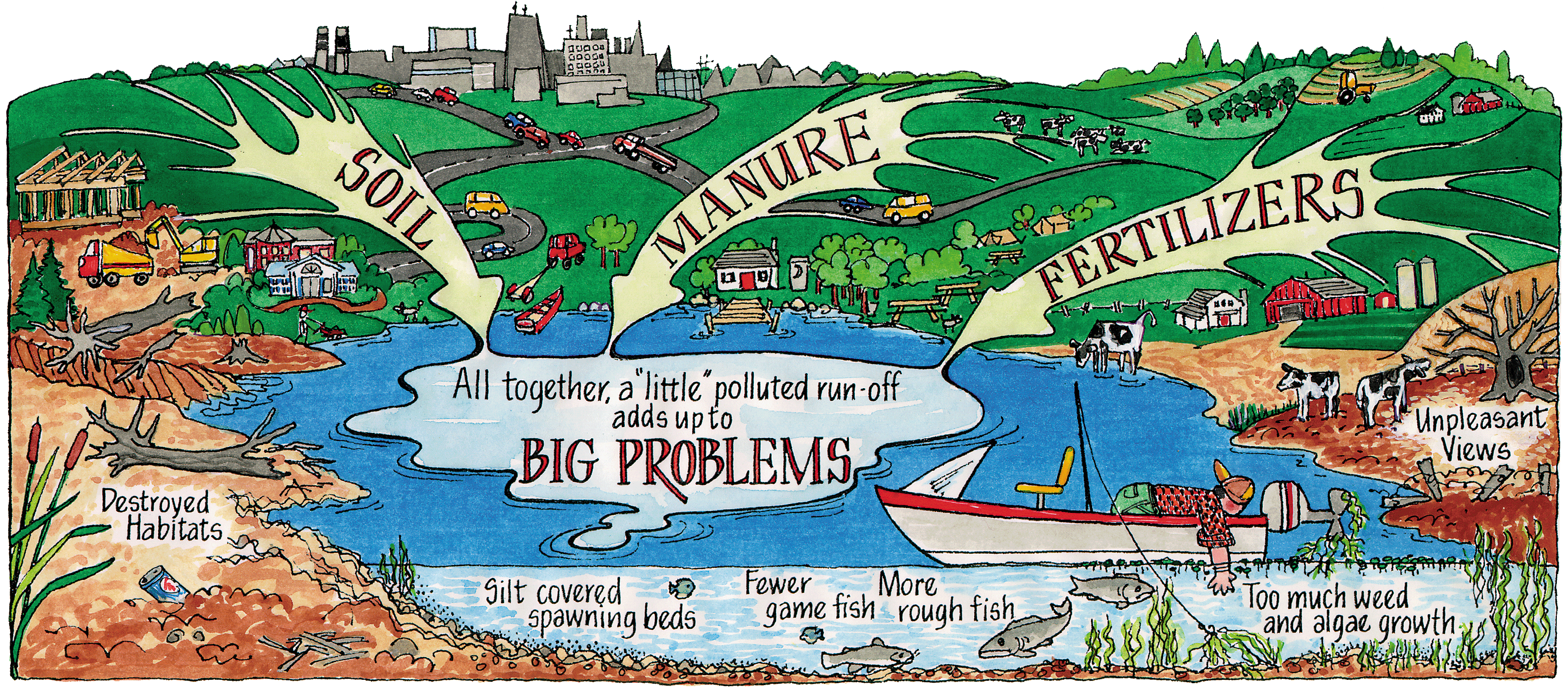
Although direct discharges are now under better control, water-quality problems linger. Ongoing water tests reveal that common water-pollution problems today are often associated with excess soil, nutrients, bacteria, and toxic chemicals. While it is clear these pollutants come from activities within the stream’s or lake’s watershed (the area of land that drains water to a common body of water), the exact source of the problem can rarely be identified. This is because the type of activity related to the problem usually occurs in multiple places on the landscape or because a pollutant (like eroded soil or fertilizers) may be associated with a few different types of activities. Pollutants that cannot be traced back to a single source are referred to as non-point source pollution (or NPS pollution).

The non-point source pollutants listed above and detailed below do not really pose any major threat to our waters, as long as they occur in individual locations, or from just one or two places. However, when these pollutants are combined and coming from multiple sources, they become a big problem!

Non-point source pollutants and associated activities include:

  • Fertilizers applied to lawns, gardens, farms, and golf courses to help plants grow lush;
  • Pesticides applied to kill weeds and nuisance insects, used on lawns, gardens, farms, golf courses, and along roadsides;
  • Soil and sediment eroded in and along stream channels, shorelines, from construction sites, and sand from winter road maintenance;
  • Bacteria and nutrients from pet waste, livestock manure, and failing septic systems;
  • Oil, gas, and other automotive fluids leaked onto the ground or pavement from cars or from construction and farm equipment.


Image source: University of Wisconsin Cooperative Extension

Non-point source pollutants are usually associated with contaminants that are easily washed off the land and into our streams, rivers, lakes and wetlands by stormwater. Stormwater includes rainfall, snowmelt, or other wet weather conditions. Stormwater that does not soak into the ground flows over the ground’s surface into streams, rivers, lakes, or other bodies of water. This over the ground flow, called runoff, will pick up pollutants as it flows across the landscape and carry them into our waters.

In Connecticut, stormwater runoff from urban areas and construction activities are two of the most significant categories of non-point source pollution (Source: CTDEP website). Stormwater runoff increases in urban areas because there are more impervious surfaces, hard and paved areas like roads, roofs, sidewalks, and parking lots that prevent water from soaking into the ground.


Source: Center for Watershed Protection

Research shows that an area with as little as 10 percent impervious surfaces has a significant increase in runoff into the body of water, causing problems like algae blooms, increased water temperatures, sediment-filled fish and wildlife habitat, and low oxygen levels that can cause fish kills.


CLEAN WATER STARTS WITH YOU!
(click to learn more)


© 2006 Pomperaug River Coalition, Inc - All Rights Reserved

Site designed by ProjectWest
Site maintained by whoistheoldguy.com